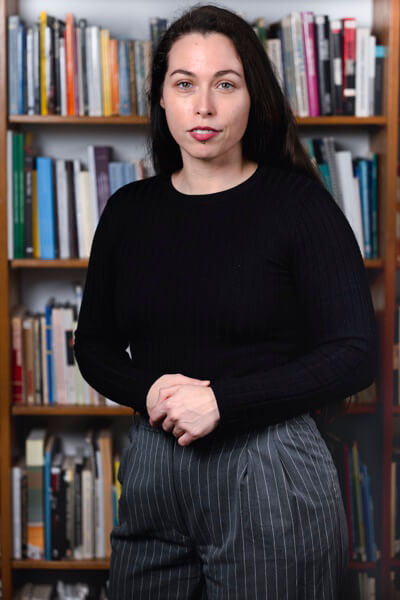
Lucija Mulalić is working for the non-governmental organisation Centre for Peace Studies as a project coordinator and member of the Supporting Inclusive Society programme. Within it, she helps in developing and advocating for just, intersectional and anti-racist policies and practices on individual, local, institutional and systemic levels. She also provides direct support to refugees and other migrants and migrant collectives, primarily through supporting migrant-led collectives and activists in building capacity for self-advocacy, as well as in their cultural production. She extensively works with different institutional actors such as local and regional authorities, public service workers, cultural centres, but also the media, students and volunteers, as well as the general public. She approaches the topics of integration and racism through a critical, transnational and decolonial lens focused on recognising cultural fluidity and hybridity, and structural class and race hierarchies as the primary source of injustice of today’s world.
Lucija is the co-leader and lecturer of the Migration course within the educational programme Peace Studies, organised by Centre for Peace Studies. She is also the co-founder and co-host of discursive programme Transnational Solidarities, held once a month in social centre MaMa, that opens up a space to provide an anti-colonial and abolitionist perspective to topics of migration, the nation-state, integration, war and conflict, the economy… Lucija graduated from the Faculty of Political Science in Zagreb with a Bachelors in Journalism and Masters in Political Science, with a focus on European and Croatian asylum law as well as international relations in continents such as South America and Africa. She has also studied Mediation, Conflict and Peace Research at the University of Tampere in Finland, with a particular focus on forced migration, autonomy of migration framework, as well as decolonial and Africana studies.
Publications:
City for Everybody ‒ Building Responsible Action for Inclusive Local Communities, National report ‒ Croatia, https://www.cms.hr/wp-content/uploads/Cifer_national_report_HR.pdf, Centre for Peace Studies, Zagreb, 2023
Shadow report on the implementation of integration measures in Croatia (editor), https://www.cms.hr/wp-content/uploads/SHADOW_REPORT.pdf, Centre for Peace Studies, Zagreb, 2023
Courses
Year of the study: 1
ECTS credits: 3
Type of instruction (number of hours L + E + S + e-learning): 1L + 2E
Expected enrolment in the course: 25
Status of the course: Elective
